
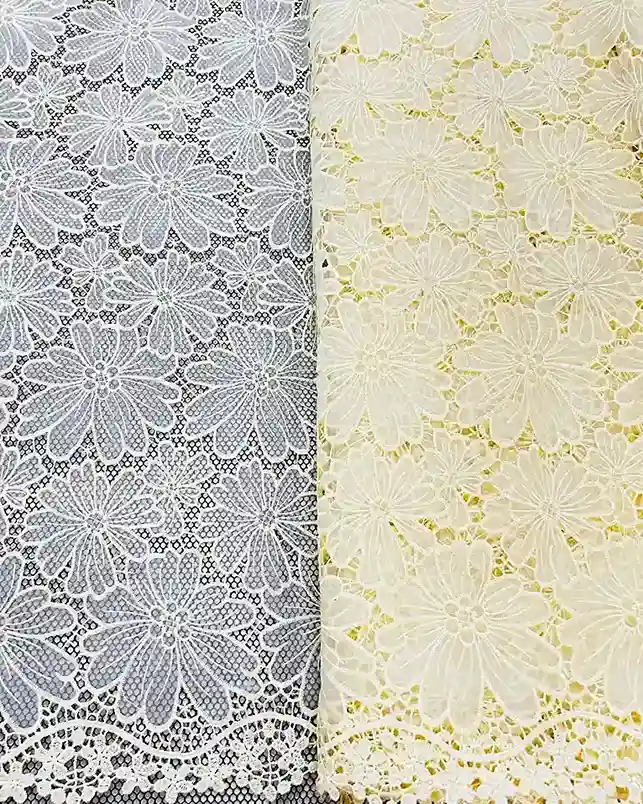
Schiffli fabric, wherever it is used, has become an essential choice for modern fashion, notably in South Asia, although its tale is deeply rooted in the past of embroidery and not simply today’s trends. A Swiss mechanical innovation, at first, was the beginning of one of the most rapidly growing embroidery traditions ever in the global textile community. Today, Schiffli embroidery is the gold standard in fabric detailing and continues to earn unchanging admiration for its intricate craftsmanship, Schiffli lace fabric, and the numerous creative patterns that are collectively referred to as Schiffli’s work designs, both by designers and consumers.
Swiss Beginning: The Birth of Schiffli Fabric
One cannot avoid going back to the 19th century if one wants to know what Schiffli fabric is. The term “Schiffli” derives from the Swiss-German language word for “little boat” that was used to describe the shuttle in the early machine. The invention of the Swiss multi-needle embroidery machine that could entirely replace the hand process was the start of the new era of fast production. This machine not only opened the doors of the textile house but also let the dainty, lace-like designs out with great accuracy at the same time.
The invention that brought forth the multi-needle embroidery machine created a whole new class of embroideries. The machine-operated method made it possible to supply the industry with very intricate and consistent designs over massive quantities since it moved the textile industry from hand stitching to machine stitching. This very change heralded the commencement of Schiffli’s ascendancy in the world.
Global Expansion and the Move to Asia
Not long after its invention, Schiffli technology traveled all over Europe and even to America and Asia’s textile centers. Manufacturers saw that they could make different cultural aesthetics with this fabric, and thus it became very easy to sell and use the fabric everywhere.
By the 1950s, India, China, and particularly Pakistan were the countries that mainly adopted the technique. The textile industry in Pakistan, which was growing and had recognized Schiffli as an asset, poured in funds for new machines and skilled staff. So the nation was transformed into the hub for the production of Schiffli embroidered fabric and one of the leading producers in the world.
Currently, Pakistan is the main supplier of embroidered yardage and Schiffli lace fabric to fashion houses, retail brands, and designers worldwide. The fabric has penetrated the markets from casual wear to bridal couture as a symbol of quality, craftsmanship, and heritage.
Modern Designs and Technological Growth
Modern Schiffli’s work designs take the traditional needlework aesthetics and combine them with high-end digital programming. With the present machinery, intricate floral patterns, geometric cutwork, borders, motifs, and entire embroidered fabrics can be made again with incredible detail.
The quality has also been raised by the use of better threads, better fabrics, and upgraded machines. What used to take hours of skilled handwork can now be done with perfect uniformity, making Schiffli the perfect mix of art and technology. To learn more about how our Schiffli embroidery can elevate your designs, get in touch with us.
FAQs
1) What is the history of Schiffli fabric?
The history of Schiffli fabric dates back to 19th-century Switzerland, when the first multi-needle embroidery machine was invented. The technology eventually circulated and settled in South Asia as a major player in the textile industry.
2) What is another name for Schiffli fabric?
It is usually called Schiffli embroidery, Schiffli lace, or Schiffli work, depending on the design and technique used.
3) Why is Schiffli so expensive?
The high cost of detailed work comes along with specialized machines, skilled workers, and time consumption. The use of high-end threads and fabrics further adds to the overall cost.
4) Is the Schiffli process still in use today?
Definitely. The embroidery of the Schiffli type is massively processed in countries like Pakistan, India, and China, as well as in some European areas. It is still in high demand for the fashion, home textiles, and bridal wear industries.
5) What is the evolution of fabric?
The evolution of fabric is that it has transitioned from being handwoven to industrial weaving, knitting, and machine embroidery. Schiffli is no doubt a major part of this evolution, as it mechanized the traditional embroidery techniques.